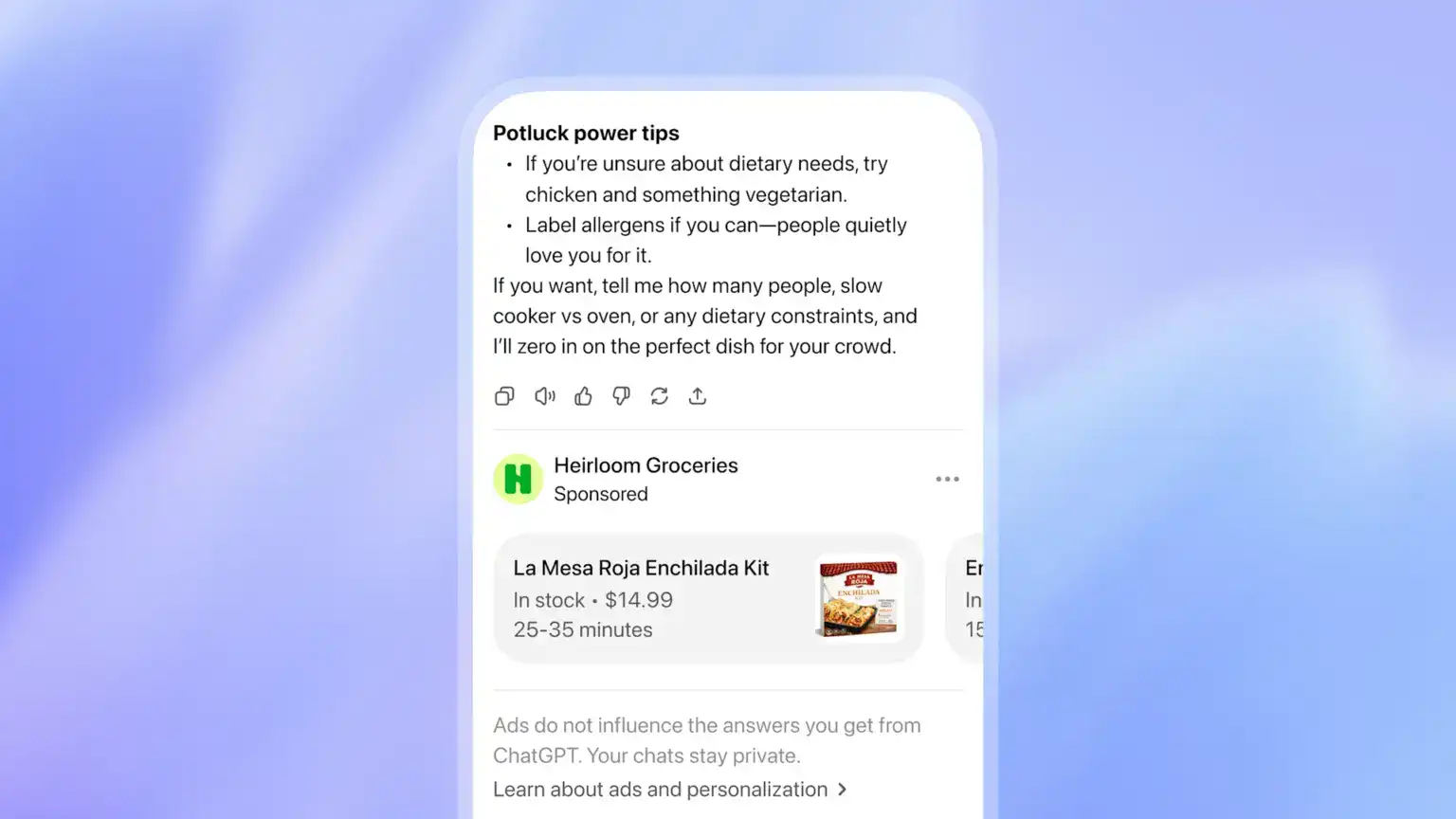
OpenAI has recently confirmed it’s testing adverts within ChatGPT for Free and Go users in the US, with plans to roll this out worldwide.
But honestly? This was always going to happen.
Free platforms rarely stay ad-free forever, especially when they’re operating on a global scale.
As the company that led the AI boom, how OpenAI chooses to monetise will likely set the tone for Copilot, Gemini, and Claude. This isn’t just a ChatGPT update; it’s a glimpse into the future of how we’ll all interact with AI.
What Has OpenAI Announced?
OpenAI has justified the move as a necessary step toward sustainability. Despite having hundreds of millions of users, they’ve reported that less than 5% of people actually pay for a subscription.
To keep the technology accessible, they’re testing a new revenue model.
With ChatGPT ads still in their first iteration, a lot will probably change in the upcoming months and years. But here’s what we know so far.
What Ads Will Appear?
Ads will be contextually matched based on your current conversation topic, your past chats, and how you’ve interacted with ads previously.
You shouldn’t see sponsored content appearing next to “sensitive topic” discussions, OpenAI has given health, mental health, and politics as examples.
Who Will See Ads?
The current proposal breaks down like this:
- Free Users: You will see ads. However, you can choose to opt out in exchange for a lower daily message limit, or you can upgrade to a paid tier.
- Go Tier: This newer £7/month tier still includes ads during the current testing phase.
- Premium Tiers: If you’re on Plus, Pro, Business, or Enterprise, your experience remains ad-free.
How Will Ads Look?
For now, the focus is on banner-style placements that appear beneath the AI’s responses. They’re clearly labelled as sponsored and visually separated from the organic answer so there’s no confusion about what’s a recommendation and what’s a paid placement.
Looking ahead, we might see more conversational formats where you can ask follow-up questions directly to the sponsored content.
What Control Will Users Have Over Ads?
OpenAI is giving users some control over adverts, and have promised that you’ll be able to:
- Dismiss ads you find irrelevant.
- See “Why this ad?” to understand the targeting logic.
- Turn off personalisation so ads are based only on the current chat, not your history.
- Clear your ad data with a single tap in your settings.
The Trust Question
This is where things get a bit sticky.
There’s a valid fear that, over time, advertising could bias the output. If a company pays OpenAI enough, will ChatGPT suggest their product as the “best” solution?
We’ve seen this play out before. Google introduced adverts and sponsored results back in 2000. Since then, the line between sponsored results and organic ones has become increasingly blurred.
A senior researcher at OpenAI, Zoë Hitzig, recently resigned and has warned that ads could lead to a system that manipulates users in ways we don’t yet understand.
On top of that, there’s stories in the news every day about inaccuracies in AI-generated content. When we’re already dealing with AI hallucinations and poisoning, adding a commercial incentive to the mix doesn’t exactly reassure users.
At the end of the day, AI systems are still young.
My take? These concerns are entirely valid. Those of us using these tools for business need to stay vigilant. If we stop believing the answers are independent, the tool loses its value entirely.
Is This an Opportunity for AI Competitors?
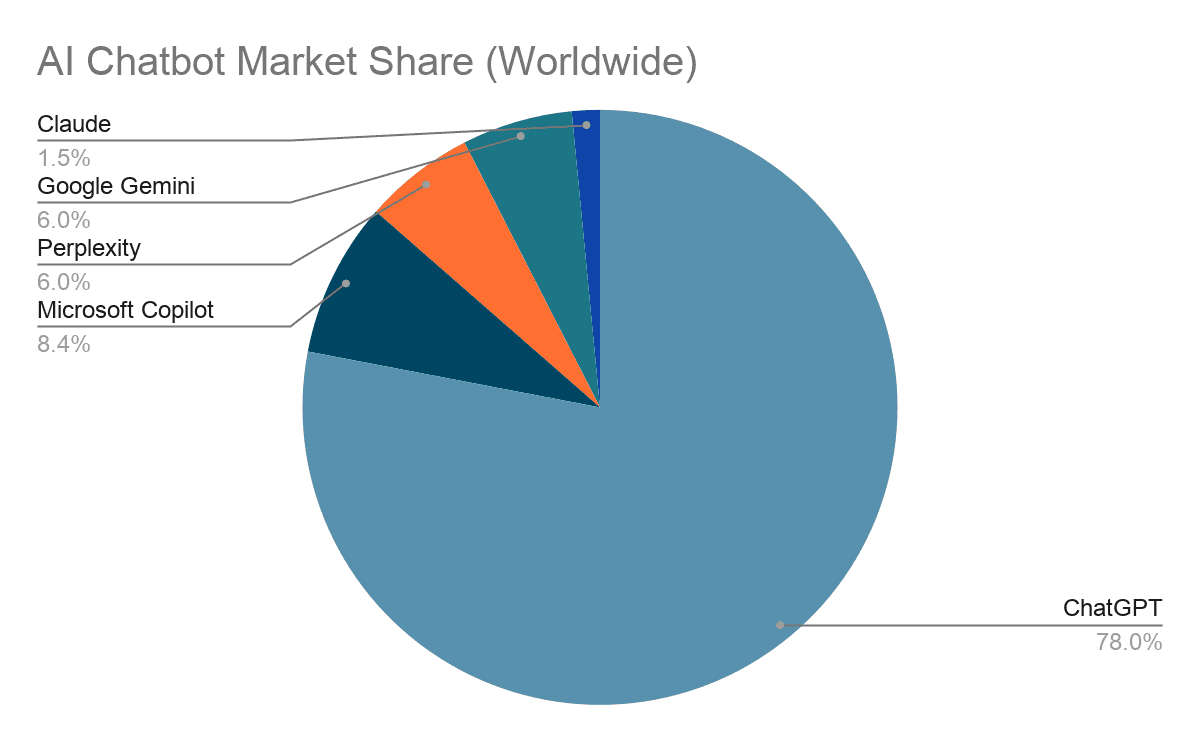
While ChatGPT dominates with roughly 80% of the market share, its rivals are smelling blood in the water.
- Anthropic (Claude): They went bold with Super Bowl ads mocking the idea of “ads in AI,” positioning themselves as the “clean” alternative.
- Perplexity: In a surprising 180-degree turn, Perplexity recently abandoned its ad strategy altogether, citing fears of eroding user trust.
If OpenAI proves that ads can be done without ruining the user experience, others may follow. But for now, the “ad-free” label is becoming a powerful marketing tool for the underdogs.
Should Your Business Advertise on ChatGPT?
It’s early days, and we’re still waiting for OpenAI to deliver a full breakdown of the ROI, but there are some potential upsides to consider:
- High Intent: You’re reaching people at the exact moment they are looking for a solution.
- Conversational Potential: Imagine a user asking your ad a follow-up question about your product’s shipping times all within the same chat.
- More Organised: It feels more targeted than a random Instagram story ad.
The unknown? We don’t yet know the click-through rates or how users will react. If the rollout becomes controversial, being the first brand to pop up might not be the win you think it is.
Navigating the Shift
Platforms evolve, and trade-offs are part of the digital landscape. It’s a reality we’ve seen time and again. Free tools rarely stay free forever without some form of compromise. But as more stories emerge about AI inaccuracies, this news makes us pause.
The biggest risk for OpenAI isn’t that we’ll all run to Claude or Gemini. The real risk is that we’ll stop trusting that the voice on the other end of our chat is looking out for us rather than its advertisers.
So, where does that leave you?
If you’re using the free version, pay close attention to how those ads feel. Do they help, or do they distract? Keep questioning the tools you use, and keep showing up authentically.
Digital marketing moves fast, and it can feel like the goalposts are constantly shifting.
If you’d like some grounded, practical advice on how to navigate these changes without the overwhelm, I’d love to chat. Get in touch with us to see how we can help you move forward with confidence.
Research:
- Anon (2026). AI Chatbot Market Share Worldwide. Statcounter Global Stats.
- Anon (2026). Our approach to advertising and expanding access to ChatGPT. OpenAI.
- Anon (2026). Testing ads in ChatGPT. OpenAI.
- Ilayaraja Subramanian (2026). Ads are coming to AI. Does that really have to be such a bad thing? The Conversation.
- Saffron Humphreys (2026). Battle of the AI Brands: OpenAI and Anthropic’s Ad War. AI Magazine.
- Theo Farrant (2026). ChatGPT will now show you adverts. Here’s everything you need to know. EuroNews.
- Victor Tangermann (2026). Another OpenAI Researcher Just Quit in Disgust. Futurism.
- Victor Tangermann (2026). Look Out, Open AI: Perplexity Admits AI Adverts Were a Mistake, Is Now Getting Rid of Them. Futurism.
- Zoë Hitzig (2026). Open AI Is Making the Mistakes Facebook Made. I Quit. The New York Times.
