

Ecommerce isn’t slowing down. If anything, it’s speeding up and Shopify’s right at the front.
This is your 2025 guide to what Shopify is, how it works and why so many businesses – from solo makers to 7-figure brands – are betting on it.
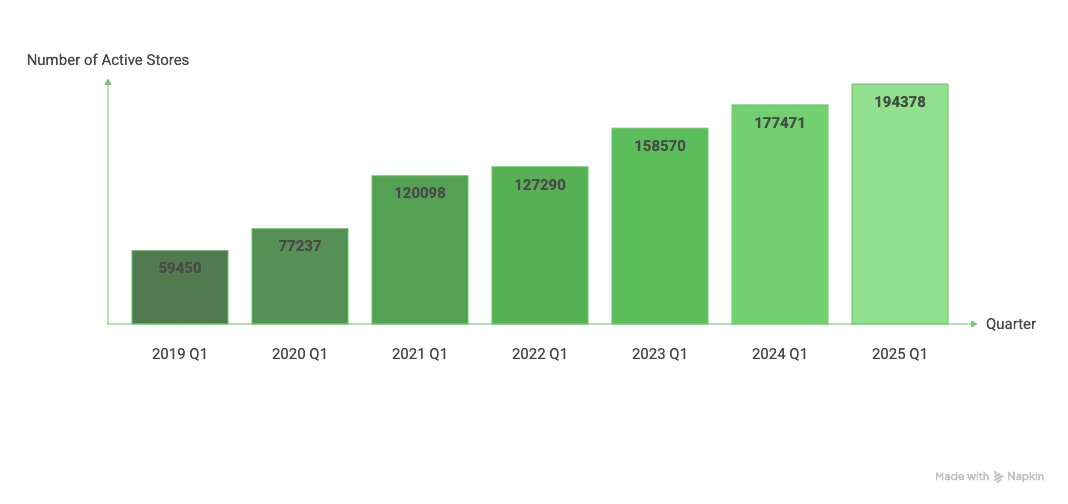
Over 4 million stores globally run on Shopify. More than 209,000 of those are in the UK. Why? Because it’s beginner-friendly, scalable and built for real growth.
If you’re building a brand, launching a side hustle or just sick of selling through platforms that take a cut and give you nothing back, this one’s for you.
What Is Shopify?
Shopify is an all-in-one ecommerce platform. That means it handles the techy stuff behind the scenes (like payments, hosting, and security) while giving you tools to build a store, sell products and grow your brand online.
It works for:
- Physical products (like skincare, coffee, clothes)
- Digital downloads (like eBooks, templates, files)
- Subscriptions (like monthly boxes)
- Services and bookings (yep, not just products)
Back in the day, it started as a snowboard shop called Snowdevil. The founders couldn’t find an ecommerce tool they liked, so they built their own. That tool became Shopify.
Fast forward to 2025 and it’s powering 1 in 5 online stores in the UK. Not bad.
How Does Shopify Work?
Shopify delivers a fully integrated toolset that helps you build, run and grow your store.
Here’s how it all fits together:
- Build and Customise Your Store: Start with one of Shopify’s mobile-ready themes, then tweak layouts, colours, fonts and more using a drag-and-drop editor. You can go even further with custom development – that’s where TH3 comes in.
- Add and Manage Products: Whether you’ve got five products or five hundred, Shopify makes it easy to upload images, write descriptions, organise variants (like sizes or colours) and manage inventory in one place.
- Accept Payments: Use Shopify Payments to take card payments directly through your store, or plug in third-party gateways like PayPal or Klarna. You can even offer digital wallets like Apple Pay and Google Pay out of the box.
- Fulfil and Ship Orders: Shopify helps you manage the full fulfilment flow – from stock alerts and shipping calculators to integrated courier services and custom tracking emails.
- Track Performance and Customer Behaviour: Built-in analytics let you monitor traffic, sales, conversion rates and abandoned carts. You can also install extra apps to dive deeper into user journeys.
- Expand Functionality With Apps: Shopify’s app store has over 8,000 options for everything from email marketing and loyalty schemes to product reviews and multi-language support. So you can keep things lean or scale up as you grow.
What Is Shopify Used For?
Shopify’s not just for online shops with rows of products. It powers everything from dropshipping setups and subscription boxes to wholesale B2B portals and hybrid businesses selling in-store and online. Whether you’re selling handmade candles, coaching sessions or a monthly membership, Shopify flexes to fit the model.
And because it’s built for multi-channel selling, you’re not limited to your own website. You can sync your store with Amazon, TikTok, Instagram or even run point-of-sale for retail pop-ups – all from one place.
In the UK, where over 88% of the population is online and there are more than 54 million active social media accounts, that kind of flexibility isn’t just nice to have. It’s what helps brands grow fast.
Is Shopify Just for Products?
No. While it’s known for product-based ecommerce, Shopify works just as well for selling services, digital downloads, online courses, subscriptions, bookings and more.
We’ve built service-led Shopify sites for clients who don’t ship a single item – they book appointments, sell memberships or deliver content online.
So if you’re not selling products, don’t count Shopify out.
Why Has Shopify Become So Popular?
Shopify’s rise wasn’t just about timing (but the ecommerce boom during COVID definitely gave it a push). It’s stuck around because it actually solves the day-to-day problems of selling online.
For beginners, it’s easy to pick up and get started. For growing brands, it scales without turning into a tech nightmare.
Everything you need, from payments and hosting to SEO and marketing, is built in or ready to plug in. It’s secure, reliable, mobile-ready and backed by one of the biggest app and theme ecosystems in the game.
No wonder over 209,000 UK stores now run on it (Q3 2025).
Key Features That Set Shopify Apart
Shopify’s packed with features that make it more than just a storefront. These tools aren’t just nice to have – they’re what turn browsers into buyers, and help teams run smoother behind the scenes.
- Shopify Payments & Shop Pay: Built-in checkout with faster payments and no third-party fees. Shop Pay also speeds things up for returning customers with saved details, which means fewer abandoned carts.
- Shopify POS: Great if you sell in-person too. Sync your stock across online and retail, manage sales from the same system, and keep all your data in one place.
- App Integrations: From loyalty tools and reviews to shipping calculators and CRM systems, there’s an app for just about everything – 8,000+ and counting. That means you can tailor your store without reinventing the wheel.
- Shopify Magic: AI tools built into the platform help you write product descriptions, automate support and make better decisions based on real-time data.
- Abandoned Cart Recovery: Remind people what they left behind with automated follow-ups. It’s one of the easiest ways to recover missed sales.
- Mobile App & Store Management: Manage orders, update products and check sales on the go. You don’t need to be tied to a desk to stay on top of things.
- Shopify Plus & Shopify Collective: For bigger brands or multi-store setups, Plus offers advanced customisation and support. Collective helps sellers collaborate with other brands, giving you new ways to reach audiences without starting from scratch.
These aren’t just features for the sake of it – they’re real tools that make running an online business simpler, faster and more effective.
How We Create Shopify Stores That Convert
Setting up a Shopify store isn’t just a checklist – it’s a launchpad. And when you work with TH3, we don’t just build the thing and leave you to figure it out. We handle the whole process, from planning to post-launch, so your site works as good as it looks.
Here’s how we bring your store to life:
Access Your Account
Starting from scratch or already got a store running? Either way, we’ll get the keys to your Shopify account and sort the setup. That means picking the right plan, sorting logins and getting everything prepped so we can hit the ground running.
Choose a Theme
Next, we find a theme that fits. Not just visually – although it’ll look the part – but functionally too. Whether we’re customising a premium layout or designing from scratch, the goal’s the same: clarity, consistency and easy browsing across every screen size.
Add Products
We’ll upload your product range, set up collections, and get the structure right from the start. That means readable descriptions, SEO-friendly tagging and product filters that actually help people find what they’re after.
Set Up Payment & Shipping
Then we configure the back-end bits that make the shop actually run. We’ll set up Shopify Payments (or your preferred gateway), define your shipping zones and rates, and make sure tax rules are right from the get-go.
Launch Your Store
Finally, we run our pre-launch checklist: mobile testing, speed checks, tracking setup and live payments testing. Once everything’s working as it should, we hit publish and your store’s open for business.

Why We Build With Shopify at TH3
We build with Shopify because it works, for our clients and for us.
Whether someone’s just starting out or scaling fast, it gives them the flexibility and control they need without getting in the way. It fits right into our workflow too. From a design and development point of view, it lets us move quickly without cutting corners. We can develop your branding, optimise for SEO and CRO, and keep everything running smoothly behind the scenes.
That said, Shopify’s not the only option. We also build on WooCommerce, especially for clients who need a little more technical control or already work in WordPress.
If you’re not sure what platform fits best, we’ll help you figure it out.
Is Shopify Right for You?
It depends on your goals. But if you want a site that looks good, runs smoothly and helps you grow – Shopify ticks a lot of boxes.
Start small. Scale fast. Keep full control.
Wondering if it’s the right fit? Let’s talk.
FAQs
What is Shopify used for?
Shopify is used to create and manage online stores. You can sell products, services, subscriptions, digital files and more.
How much does it cost?
There are four main plans:
- Basic – best for new stores
- Grow – ideal for small teams
- Advanced – for growing businesses
- Plus – for bigger teams or higher volumes
Heads up: some apps, themes or add-ons cost extra. But it’s still solid value when you consider the time saved and results gained.
What is Shopify Payments?
Shopify Payments is Shopify’s built-in payment processor. It lets you accept credit cards, Apple Pay and Google Pay without third-party fees. It integrates seamlessly with Shop Pay and Shopify POS and it’s available in most major countries, including the UK.
It also means faster checkout, fewer abandoned carts and one less dashboard to manage.
Can I sell on social media?
Yes. Shopify connects directly to Instagram, TikTok, Facebook, Pinterest, Amazon and more.
Is Shopify good for beginners?
Absolutely. It’s built to be easy to use, but flexible enough for serious scaling.
Can I use Shopify in the UK?
Yep. It’s fully supported in the UK and powers over 209,000 stores here.
What can I sell on Shopify?
Anything from fashion and food to digital products, memberships and events.
Is Shopify scalable for big businesses?
Definitely. Shopify Plus is designed for high-growth brands with custom needs.
Sources
- Joe Hitchcock (2025). What Is Shopify and How Does It Work? Shopify.
- Anon (2025). What is Shopify Used For in 2025? A Comprehensive Guide to E-Commerce Success. Firebear Studio.
- Lacho Shoykov (2024). Reinventing e-Commerce: The History of Shopify. Craftberry.
- Anon (n.d.). How Shopify Grew From a Snowboard Shop to a $10B Commerce Ecosystem. Product Habits Blog.
- Trish Novicio (2021). 15 Biggest Companies That Use Shopify. Yahoo! Finance.
- Nic Dunn (2024). Top 32 Shopify statistics, facts & figures in 2025. Charle.
- Anon (2024). Most Popular Ecommerce Platforms (2023 Stats). Ecommerce Gold.
- Simon Kemp (2025). Digital 2025: The essential guide to the global state of digital. We Are Social.