

eCommerce isn’t slowing down. It’s growing fast, and it now accounts for over 23% of global retail sales. That’s a big massive slice of the pie, and it’s only going one way.
So if you’re selling online (or planning to), choosing the right platform matters. A lot.
This is where most businesses hit a wall. There are loads of options out there, all promising the same things. Flexibility. Scalability. Growth.
Most of our conversations at TH3 come down to two platforms: WooCommerce and Shopify. Both are solid options. Both can work brilliantly. But they’re built differently, and that affects how your business runs day to day.
What Do eCommerce Platforms Do?
At their core, eCommerce platforms give you the tools to build, manage, and grow an online shop. You’re looking at things like:
- Product management
- Payments
- Checkout
- Order processing
- Integrations with other tools
That’s the baseline. Every platform worth using will cover those.
Where it gets interesting is how they do it.
Because the platform you choose doesn’t just affect what your site looks like. It impacts how flexible it is, how it scales, and how much effort it takes to keep things running.
It also affects things behind the scenes – like site speed, mobile performance, and how easy it is to update content. All of which directly influence how well your site converts.
Some platforms give you full control but expect you to know what you’re doing. Others take care of everything, but put limits on what you can change.
That trade-off is exactly what sits between WooCommerce and Shopify.
WooCommerce: Flexible and Customisable
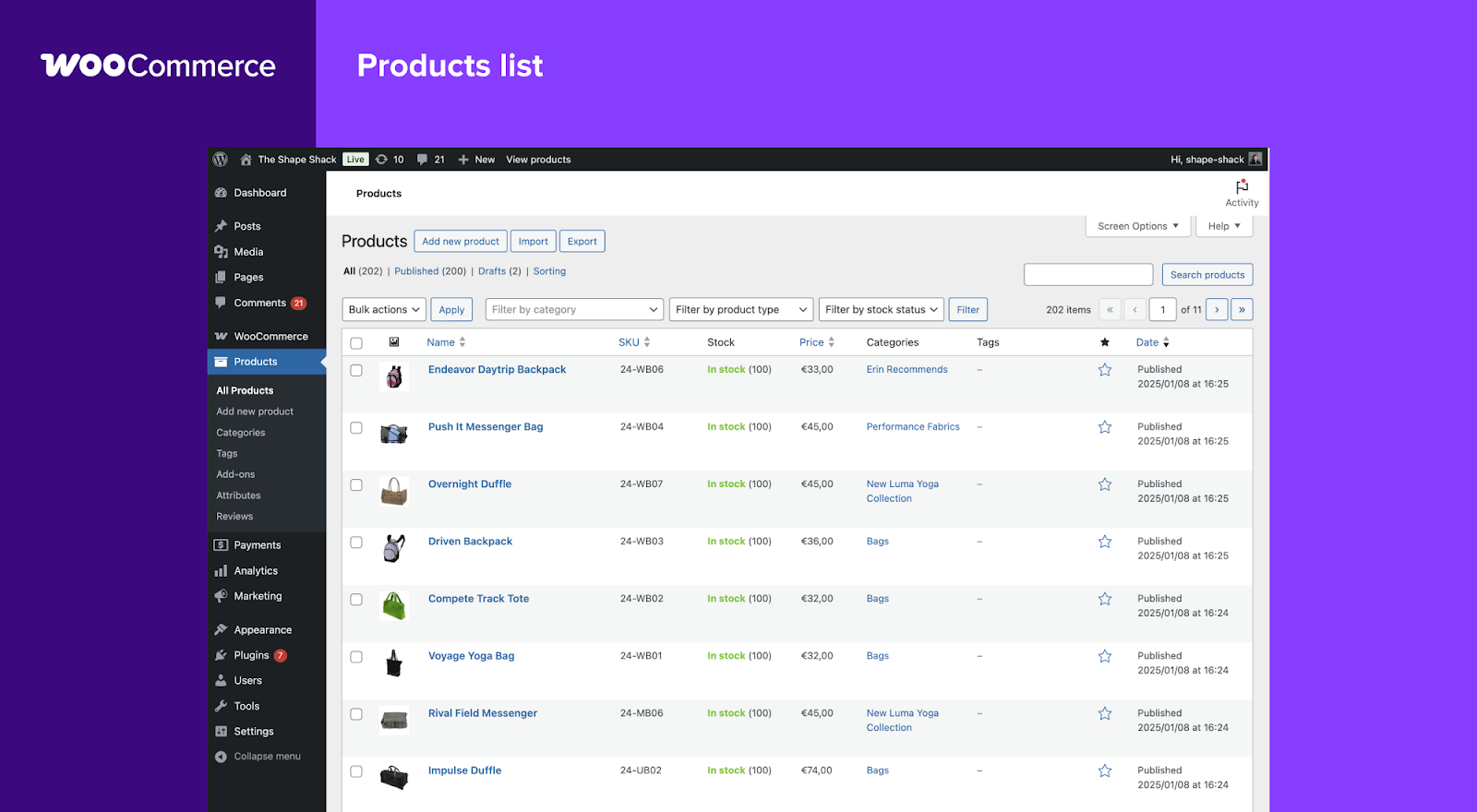
WooCommerce is a plugin for WordPress. So instead of being a standalone platform, it turns a standard website into an eCommerce store.
That’s both its strength and its biggest challenge.
Pros
On the plus side, it’s incredibly flexible. If you can think it, you can usually build it. Custom layouts, bespoke functionality, complex product setups, integrations with just about anything… it’s all on the table.
That flexibility shows up in a few key ways:
- Custom layouts and fully bespoke design
- Complex product setups and variations
- Integrations with CRMs, APIs, and third-party tools
- The ability to shape functionality around your business, not the other way round
We’ve used it on projects where eCommerce is only part of the picture. Think content-heavy sites, lead generation, or businesses that need a mix of services and products. It works really well there.
You also get full control over your design and functionality. No templates boxing you in unless you choose to use them. We can scaffold layouts properly, build reusable components, and create logic blocks that actually match how your business works.
From an SEO point of view, it’s strong too. WordPress gives you a solid foundation for content, which is ideal if organic traffic is a big driver for you.
Another advantage is ownership. With WooCommerce, everything sits within your environment — your hosting, your setup, your data. That gives you more control long term, especially if your site needs to evolve over time.
Cons
WooCommerce isn’t plug-and-play. It comes with a bit more responsibility:
- You’ll need to manage hosting and performance
- Updates (core, plugins, security) need to be handled properly
- Plugin compatibility can become an issue if not structured well
- Ongoing maintenance increases as your site grows
If it’s not set up properly, it can get messy quite quickly.
That’s usually where we come in. Without the right structure and support, WooCommerce can go from flexible to frustrating.
Best Fit?
If your site isn’t purely eCommerce, if content matters, or if you need something bespoke, WooCommerce gives you the freedom to build it properly.
Shopify: Streamlined and Easy to Manage
Shopify sits at the other end of the spectrum.
It’s a fully hosted platform, built specifically for eCommerce. Everything is bundled in. Hosting, security, updates – it’s all handled for you. That’s the big appeal.

Pros
You can get a store up and running quickly, and you don’t need to worry about the technical side of things day to day. The interface is clean, the setup is straightforward, and most people can get to grips with it pretty quickly.
Where Shopify really stands out is in how simple it makes things:
- Hosting, security and updates are all handled for you
- Clean, user-friendly dashboard
- Quick setup with minimal technical input
- Built-in tools for payments, shipping and order management
From a developer’s point of view, it’s efficient. We can still build custom themes, structure components properly, and extend functionality through apps or custom code where needed.
Shopify’s app ecosystem is strong as well. If there’s something you need, there’s usually an app for it.
It also handles scaling really well. As your store grows, the platform takes care of performance, hosting and infrastructure in the background. That removes a lot of the pressure from your team.
Cons
You are left working within a system.
There are a few trade-offs to be aware of:
- Less flexibility compared to WooCommerce
- Custom functionality can require workarounds
- Ongoing subscription and app costs
- Some limitations around design and structure
Customisation can feel a bit boxed in at times too. You can absolutely build a high-performing site on Shopify, but if you want something very specific or unconventional, it might push back.
Best Fit?
If you’re eCommerce-first, product-focused, and you want something that’s quick to launch and easy to manage, Shopify does the job really well.
WooCommerce vs Shopify: The Key Differences
When people ask me which one is better, the answer is always the same: neither. Because it completely depends on how you want your website to work.
Here’s a basic overview:
| Feature | WooCommerce | Shopify |
|---|---|---|
| Flexibility | Very high, fully customisable | Moderate, more structured |
| Ease of Use | Moderate, steeper learning curve | High, easier for non-technical users |
| Setup | Manual, more involved | Quick and straightforward |
| Scalability | High, but needs planning | Very high, handled for you |
| SEO & Content | Strong for content-led strategies | Capable, but more limited |
| Best for | Hybrid websites | Pure eCommerce brands |
That’s the simplified version.
WooCommerce gives you control. Shopify gives you convenience.
Which Should You Choose?
This is usually the point where people want a straight answer.
But the reality is, the right choice depends on your business model, not just the platform features.
Choose WooCommerce if:
- Your website isn’t purely eCommerce
- You rely on content, SEO, or lead generation
- You need flexibility or bespoke functionality
- You want full control over how everything works
Choose Shopify if:
- eCommerce is your main focus
- You want something simple to manage
- You’d rather not deal with hosting or technical maintenance
- Speed and ease of use matter more than deep customisation
There’s no universally “better” option. Just the one that fits how your business operates.
It’s Not Just About the Platform
WooCommerce and Shopify are both good options. I work with both regularly, and I’d happily recommend either – when they’re used in the right way.
It’s not about picking the “best” platform.
It’s about picking the one that fits your business.If you’re deciding between WooCommerce and Shopify and you’re not sure which way to go, get in touch. We’ll look at what you’re trying to achieve, how your business works, and help you make a call that actually makes sense.