

If you’ve spent any time in digital marketing forums lately, you’ve probably seen the headlines: “AI is killing SEO!” It’s a bold claim.
But here’s the truth – SEO isn’t going anywhere. It’s just evolving with the search landscape.
In this guide, we’ll explore how AI is impacting search and explain why the fundamentals of SEO still matter more than ever. Whether your content shows up in traditional search results or new AI-powered tools, the strategy behind getting seen hasn’t disappeared – it’s just shifting.
How Is AI Affecting SEO?
Let’s break it down. There are two main routes AI has taken into the world of search:
- AI tools integrated in traditional search engines, like Google’s AI Overviews.
- AI-native platforms introducing their own search features, like ChatGPT’s Search tool launched in July 2024.
These tools don’t just list links. They aim to answer questions directly, often pulling from multiple sources and presenting a unified response. Yes, they usually cite sources – but that doesn’t always mean they send users to your website.
This shift has contributed to a rise in zero-click searches, where users get their answers without ever visiting a website. And yes, this does affect your organic performance.
But here’s the thing: AI may be changing search habits, but users are still overwhelmingly turning to traditional search engines. Google, in particular, remains dominant. In August 2025, 95% of ChatGPT users still visited Google. And Google still reigns with 83.8 billion visits compared to ChatGPT’s 5.8 billion.
So yes, AI is reshaping how people get information, but traditional search isn’t going anywhere. And that means your SEO strategy is still essential.
What Hasn’t Changed – And Probably Won’t
Despite all the noise around AI, traditional search is still the biggest digital channel by far.
Search drives more website traffic than any other digital channel, with 68% of all website traffic still comes from traditional search engines.
That’s not a signal that SEO is dying – it’s a reminder that it remains essential.
People still start with search when researching a product, solving a problem or looking for a business. It’s how brands get found.
Even as Google’s market share dipped below 90% at the end of 2024 – the first time since 2015 – the numbers still speak volumes:
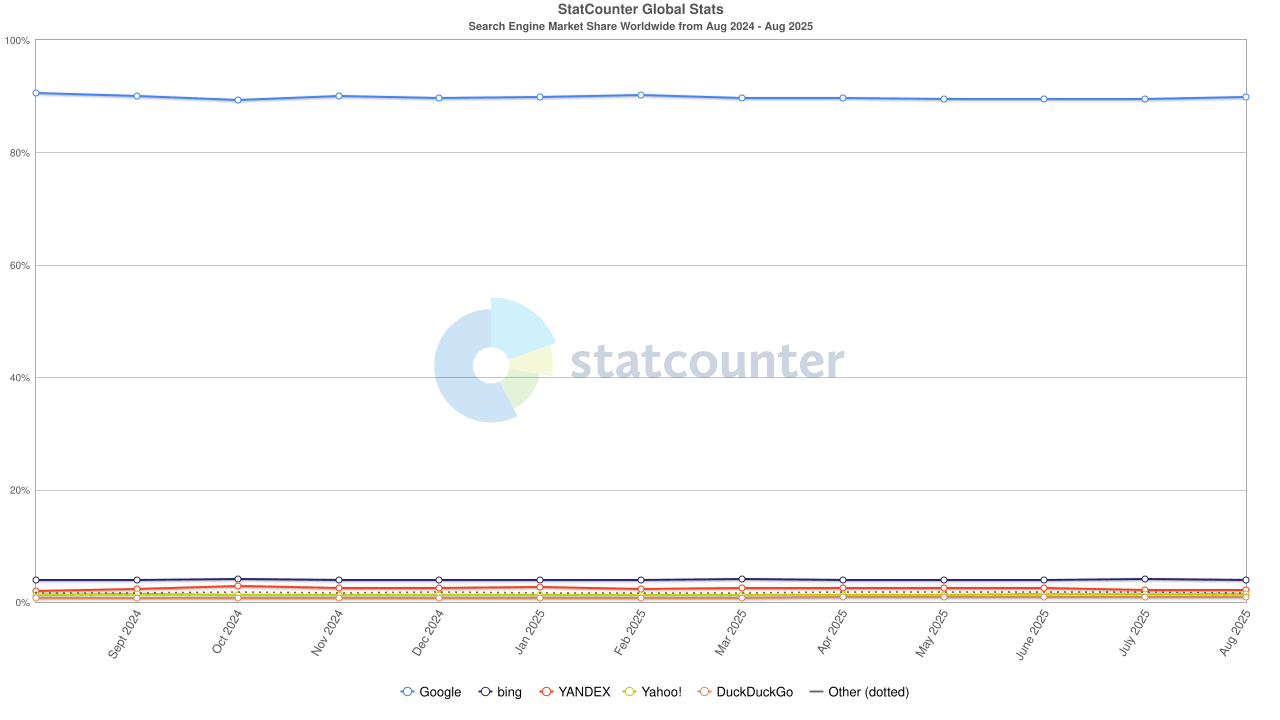
These platforms might seem small, but together they signal a broader shift in search behaviour and a wider playing field for your SEO strategy.
As for AI usage: Google had 83.8 billion visits in August, compared to ChatGPT’s 5.8 billion.
Search is still king.
SEO for AI-Search Is Still SEO
You might’ve heard the term “Generative Engine Optimisation” (GEO) being thrown around lately, suggesting we’re entering a new era. But don’t be fooled. GEO isn’t replacing SEO. It is SEO.
AI tools like ChatGPT Search and Google’s AI Overviews rely on the same types of content that traditional search engines do: well-structured, high-quality, trustworthy pages.
- AI models need structured data to understand your content.
- E-E-A-T (Experience, Expertise, Authoritativeness, Trust) still matters.
- Concise, scannable content gets pulled into summaries and voice search answers.
- Reputation signals help determine which sites are referenced or cited.
If your site already ranks well in traditional search, chances are it’s primed for AI visibility too. The job now is to expand your optimisation strategy to account for how these tools surface content – not to throw your SEO playbook out the window.
5 SEO Shifts You Should Be Making Now
The fundamentals of SEO haven’t changed – but how and where they’re applied is evolving. If you want to future-proof your search strategy, these are the five areas where you should focus your efforts next.
1. Create People-First Content
Since Google’s Helpful Content Update in 2022 (now part of the core algorithm), writing content that prioritises people – not search engines – has become essential.
That means writing for people first, search engines second.
Helpful content:
- Is written with a clear audience in mind
- Demonstrates first-hand expertise or real-world experience
- Fully answers the user’s query and anticipates follow-up questions
- Offers original insights and analysis
Google penalises low-quality, keyword-stuffed content. So do users. The better your content is for your audience, the more visible you’ll be – both in traditional search and AI-powered experiences.
The best way to stay aligned with Google’s expectations? Use E-E-A-T and the “Who, How, Why” framework to shape your content. Not only will this improve your rankings but it also increases your odds of being featured by AI-search tools.

2. Become the Topical Authority
In SEO, depth beats breadth. Instead of covering everything, own your niche.
Topical authority means you’re the go-to expert on a specific subject. Google rewards this kind of clarity and so do AI tools. Build your strategy around:
- Breadth: Cover the key subtopics, FAQs and related themes
- Depth: Answer questions fully, not just with surface-level info
- Entity alignment: Mention relevant tools, terms, people and places
- Internal linking: Build structured clusters around each topic
- Trust signals: Use author bios, credible links and up-to-date pages
This makes your site quotable – by search engines, AI tools and users. The result? More visibility across traditional and AI search platforms.
3. Structure for AI Crawlers
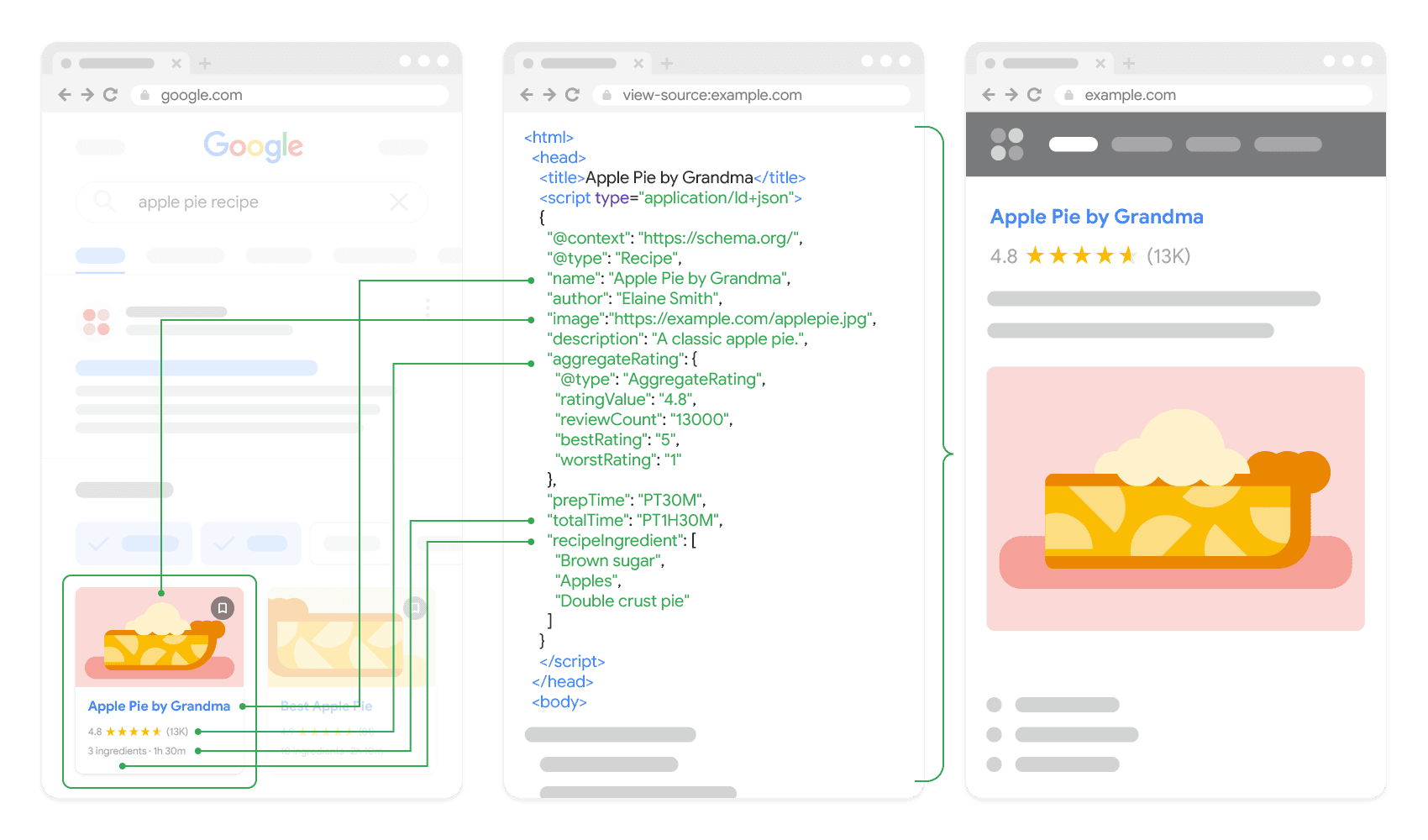
AI tools rely on structured data to interpret and use your content effectively.
Think of structured data – delivered through schema markup – as your content’s translator. It tells machines like Google, Bing and AI tools exactly who you are, what you offer, and how your pages relate to each other and the wider web.
Google, Microsoft and OpenAI have all confirmed they use structured data to improve their AI-generated search experiences. It’s used to:
- Define key entities like people, services, locations and products
- Connect your content to related topics, building a knowledge graph around your brand
- Increase visibility in rich results, voice assistants and AI Overviews
Start with an audit to spot gaps. Define your brand’s key entities and apply consistent markup. Also, structure your content visually with clear headings, bullet points and layouts – it helps humans and machines alike.
4. Think Beyond Just Google
Google might dominate, but it’s not the only game in town. And smart SEOs are diversifying.
Bing has over 100 million daily active users and growing ad revenue (+21% YoY in FY25 Q3). Its AI-driven search tools are genuinely useful:
- Bing Generative Search: Like AI Overviews, but with more clickable results
- Copilot Search: Chat-style search that increases engagement and discovery
Meanwhile, YouTube (owned by Google) is now the second-biggest search engine. AI tools frequently reference YouTube content – so video SEO plays a vital role in modern visibility.
And don’t ignore your own analytics. You may find more traffic coming from ChatGPT or Bing than expected – especially if you’re in tech, finance or education.
Diversifying your SEO strategy helps protect your visibility as search evolves. Don’t put all your ranking eggs in Google’s basket.

5. Keep Monitoring and Adapting
If there’s one constant in SEO, it’s change. Google alone released four core updates and three spam updates in 2024. The March 2024 update was particularly disruptive to organic performance.
That’s why your strategy should never be static.
Monitor what’s working – not just in traditional search, but in AI tools too. Ask:
- Are you getting more or less traffic from organic?
- Are you being cited or surfaced in AI-generated answers?
- Are you seeing more zero-click impressions?
Tools like SEMRush and Ahrefs now offer AI SERP tracking, helping you spot where you’re appearing in tools like AI Overviews or ChatGPT Search. And Google Search Console shows AI Mode performance in its reports, although you won’t yet be able to break that data out from traditional web search. Still, it’s a useful starting point.
Stay curious. Adapt quickly. Invest in tools that help you see how AI is shaping your visibility.
Why SEO Still Matters in the Age of AI
Let’s bring it back to the big picture:
- Search still drives the majority (68%) of web traffic
- Google sends 37x more traffic than ChatGPT to some major publishers
- Even die-hard AI users double-check answers in traditional search
AI is changing how content gets surfaced. But SEO is what gets your content there in the first place.
If you want sustainable digital growth, SEO isn’t optional.
SEO Isn’t Dead – It’s Just Growing
The future of search is evolving – fast. But if you stay focused on creating helpful, authoritative content that users (and AI) can trust, you’ll stay ahead.
We’re not watching SEO die. We’re watching it grow up.
Need help future-proofing your strategy?
Talk to us at TH3 Design. We’ll help you adapt your SEO approach for a world where both people and AI are searching.
Sources
- Barry Schwartz (2022). Google’s new helpful content update targets sites creating content for search engines first. Search Engine Land. Available at: https://searchengineland.com/googles-new-helpful-content-update-targets-sites-creating-content-for-search-engines-first-387237
- Barry Schwartz (2025). Google Search Console to show AI Mode performance but you won’t be able to break it out. Search Engine Land. Available at: https://searchengineland.com/google-search-console-to-show-ai-mode-performance-but-you-wont-be-able-to-break-it-out-455992
- Danny Goodwin (2025). Nearly All ChatGPT Users Visit Google. Search Engine Land. Available at: https://searchengineland.com/nearly-all-chatgpt-users-visit-google-461830
- Google (2025). Creating Helpful, Reliable, People-First Content. Google Developers. Available at: https://developers.google.com/search/docs/fundamentals/creating-helpful-content
- Jane Cozens (2025). Topical authority: How to become the go-to resource on your topic. Search Engine Land. Available at: https://searchengineland.com/guide/topical-authority
- Jonathan Theuring (2025). Bing vs Google: Search Engine Comparison 2025. Impression. Available at: https://www.impressiondigital.com/blog/bing-differ-google/
- Martha van Berkel (2025). Structured Data’s Role In AI And AI Search Visibility. Search Engine Journal. Available at: https://www.searchenginejournal.com/structured-datas-role-in-ai-and-ai-search-visibility/553175/